
Millburn City Directory Collections
Millburn's strongest local directory source is the library's DigiFind-It archive. It brings together historical names, businesses, institutions, locations, newspapers, and local publications. The directory material spans 1850 through 1981, but the archive expressly notes gaps. That means a missing year is a gap in the available run, not evidence that a person left Millburn. Some volumes are regional, so a search for a Millburn household may also need the Short Hills, Summit, Springfield, or Wyoming label used in that volume.
| Collection | Years | Where Held | Access |
|---|---|---|---|
| Millburn, Summit, and Springfield directories | 1850-1981, with gaps | Millburn DigiFind-It and library | Digitized PDFs and viewer; confirm unscanned holdings with library staff |
| Price & Lee regional volumes | Sampled 1938 and 1950 | Millburn DigiFind-It | Online scans with page navigation and varying OCR quality |
| Local newspapers and publications | The Item 1889-1891 and 1930-2025; Cartoon 1873-1874; Budget Book 1986 | Millburn DigiFind-It and library | Digital archive; verify OCR against the page image |
| Homes, People, and Real Estate Records | Current online archive, not an annual directory run | Millburn-Short Hills Historical Society | Browsable archive; selected reproduction may be member-supported |
The New Jersey directories index identifies a Millburn run for 1962 through 1981, while the local scans remain the better first stop when a volume is available. The library is also the practical in-person fallback for unscanned directories, local newspapers, yearbooks, and licensed databases. Ask staff what is currently on the shelf rather than assuming that every directory named in an index is physically available.
Note: A regional title can contain a Millburn address even when the cover names several neighboring communities.
Millburn Directory Years Have Gaps
The local run should be read as a set of surviving, digitized volumes rather than a complete annual record. The archive describes coverage from 1850 to 1981 with gaps, and the research found no definitive first or last continuous Millburn-only annual series. The 1938 and 1950 examples are both regional Price & Lee publications. Their combined geography is useful, but it also means a name can appear under more than one community label or section heading.
For a hard-to-find household, work outward from the year you can locate. Search the surname with and without a first initial, then inspect the alphabetical and numerical sections. A change in street spelling, a widow's listing, a boarder, a business name, or a Short Hills instead of Millburn label can explain an apparent break. The collection does not establish a yearly residence history by itself. Deeds, census schedules, and newspaper notices serve different purposes and should be compared rather than treated as duplicates.
| Date or run | Millburn directory milestone |
|---|---|
| 1850 | First year named in the library archive's available directory span, not proof of uninterrupted annual publication |
| 1938 | Digitized regional Price & Lee volume available in the local viewer |
| 1950 | Regional Price & Lee volume documents the five-part arrangement, including alphabetical and numerical street sections |
| 1962-1981 | Millburn run identified in the New Jersey directories index, subject to the local archive's gap caution |
| 1981 | Last year in the archive's stated 1850-1981 span; a definitive continuous Millburn-only endpoint was not located |
Millburn Directory Archive Access
The Millburn Free Public Library, at 200 Glen Avenue, is the local point of contact for historical collections. Its listed hours are Monday through Thursday, 9:30 a.m. to 8:45 p.m.; Friday and Saturday, 9:30 a.m. to 5:15 p.m.; and Sunday, 1:00 p.m. to 4:45 p.m., except Sundays in August. The library phone is 973-376-1006. Hours, shelf locations, and database access can change, so call before making a trip for an unscanned volume.
The Millburn digitized archive groups directory scans with newspapers, a History of Millburn Township e-book, Houses of Worship, and Other Publications.
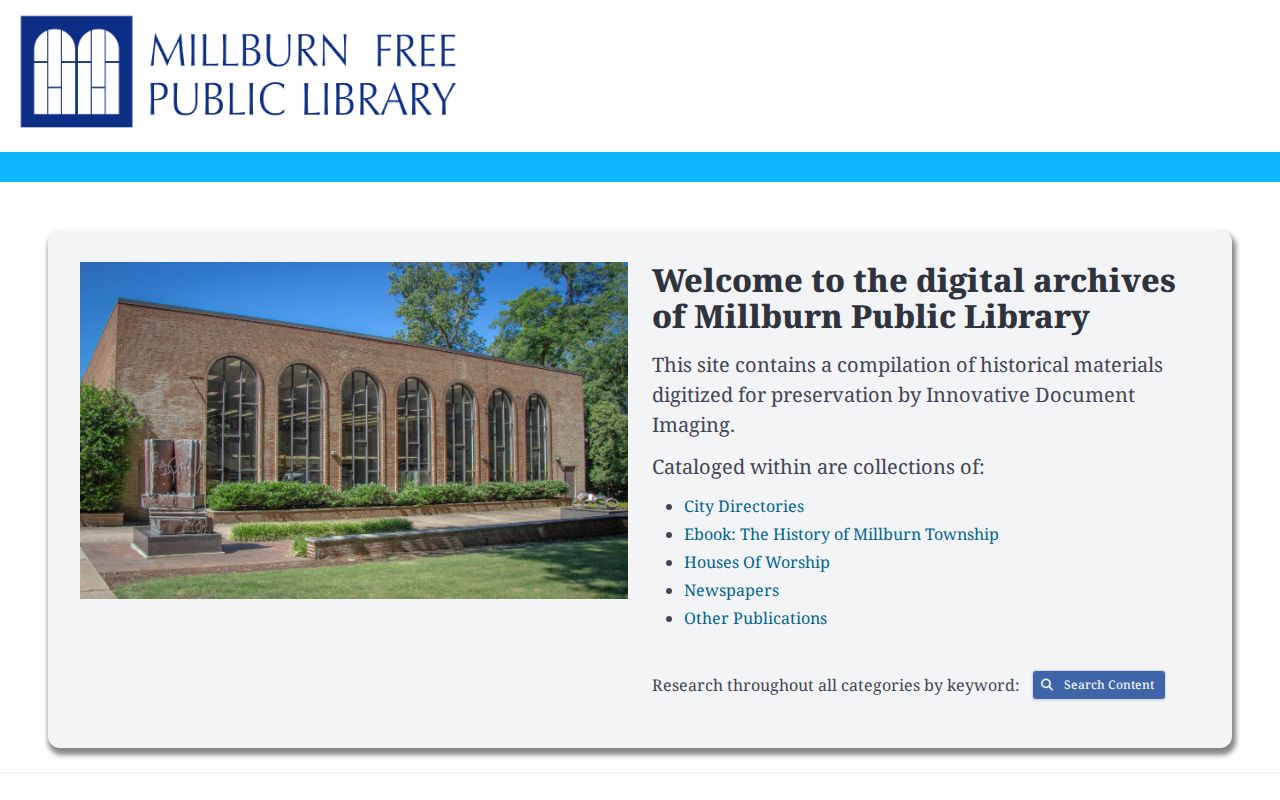
Those companion collections can supply a church name, event date, business clue, or local spelling that improves a directory search. A newspaper hit remains a lead until the underlying page and, where needed, the responsible public custodian are checked.
Library access is one channel, not the only one. The free archive is best for a first pass. Staff can clarify current physical holdings. The Historical Society is better for photographs, maps, and address-specific history, while the State Archives and Essex records offices hold different civil and land series.
Price and Lee's Millburn Directory
The 1950 Summit, Millburn, Springfield Directory was published by Price & Lee Co. of Newark. Its title page describes five distinct parts: governmental, buyers', classified, alphabetical names with occupations and addresses, and numerical streets with householders and businesses. The practical name search begins in the alphabetical portion. The address-to-householder route is the numerical street portion.
| Title and scope | 1950 Summit, Millburn, Springfield Directory, with Short Hills in its classified coverage |
|---|---|
| Name entry | Indexed surname and given name, plus occupation or business and street address when shown |
| Street entry | Numerical street order with householders and businesses, useful for a historic address check |
| Household clues | A spouse, relationship, occupation, or other publisher notation may appear only where visible in the chosen volume |
| Access limits | Digitized PDF or viewer; scan quality, page navigation, and OCR can vary |
The 1938 Price & Lee viewer shows the same regional concept and five-part arrangement. Do not assign a universal meaning to a mark from memory. Read the front-matter key in the actual volume before recording an abbreviation, and report a spouse or other notation only when it is visible on the selected page.
Reading a Millburn City Directory Entry
A historical entry is a compact finding aid. It can supply a surname spelling, initial, occupation or business, and a street address. The entry does not necessarily identify every person in a house, and it does not resolve whether a listed owner also lived at the parcel. Compare the alphabetical entry to the numerical street listing, then keep a note of the page and year. That small citation makes it possible to recheck a reading when a scan is unclear.
- Criss-cross directory
- A reverse directory arranged by street and number instead of by surname. In the 1950 local volume, the numerical street section supplies this address-first view.
- Householder index
- An address-oriented listing that names the householder or business associated with a numbered street entry. It is not a complete household census.
- Abbreviation key
- The publisher's explanation of shortened terms and marks, normally found in the volume's opening material. No universal key was independently located for every Millburn scan.
Use the entry as a bridge between sources. A name can lead to an obituary notice or census household. A number can lead to a map or a recorded deed. For a present-day parcel trail after an old address has been identified, the Millburn by-street directory follows the current address records rather than repeating the historical collection search.
Note: Directory entries are reported snapshots, so an absent name can reflect a gap, an editorial choice, or a changed label.
Millburn Directory Maps and Homes
The Millburn-Short Hills Historical Society archive provides an address-friendly companion to the directory volumes. Its categories include People, Homes, Real Estate Records, Maps, Businesses, Clubs and Organizations, Schools, Religious Institutions, Photographs, and Postcards. Captured August 2026 counts included about 15,710 entries overall, 5,598 real-estate records, 2,103 people entries, and 1,446 home entries. Those counts can change and are not a count of township residents.
The Historical Society archive uses an exact-address convention. A house entered as “67 West Road, Short Hills” is searched as “WestRoad67SH.”
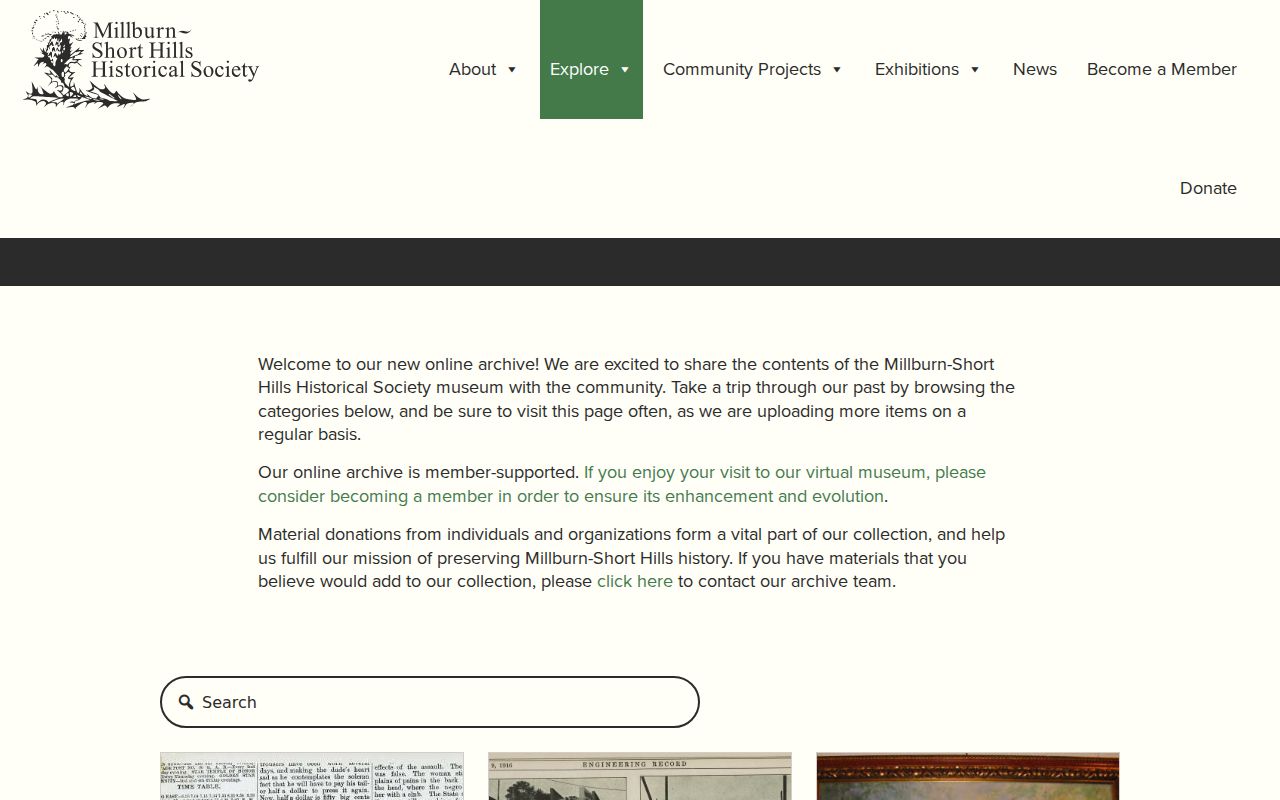
The result can add a photograph, map, real-estate clue, or community context to a directory address, subject to the archive's access and reproduction rules. It should not replace a deed, census, or certified record when those are the question.
The Society's Map Room includes Sanborn maps from 1886, 1895, and 1912, along with local atlases and a 1949 proposed Essex Street change. Maps can connect an old street label or building footprint to a later address. They establish physical context, not occupancy.
Millburn Directory Newspaper Clues
When an available directory year ends, the local newspaper runs can help bracket a household's time in Millburn. DigiFind-It lists The Item for 1889 through 1891 and again for 1930 through 2025, Cartoon for 1873 through 1874, and a 1986 Budget Book. Search for obituaries, marriage notices, school events, civic-club reports, and property announcements using the spelling and address first found in a directory.
OCR is useful but imperfect. Inspect the page image before copying a name, date, or street number. The research did not identify a current library obituary index, a central funeral-home archive, or a searchable municipal burial database. Church custodians, the library, the Historical Society, and a focused records request are the documented alternatives for a particular historic question.
Tracing Families in Millburn Directories
Follow one household across the available volumes, not across imagined annual coverage. Record the exact surname form, first initial, street, occupation or business, and page. Then compare the entry with the numerical street section for the same year. A change of initials, a widow's listing, a boarder, or a Millburn-to-Short Hills label can be the useful clue, but it needs a second source before it becomes a conclusion.
- Start with the earliest or clearest available entry for the name or numbered street.
- Copy the spelling, address, page, occupation, and any mark only after checking the volume's key.
- Compare the alphabetical entry with the numerical street listing to identify a householder or business at that address.
- Move to the next available directory year in either direction, noting changed initials, labels, or addresses.
- Pair the result with the public 1900, 1910, 1920, 1930, or 1940 federal census schedule, then use newspapers, deeds, or cemetery sources for a separate check.
Federal schedules through 1940 are public under the 72-year release rule. A census describes a household on its census date; a local directory is a commercial and local snapshot. Neither certifies title, identity, or a vital event. If a name disappears, consider a move, death, changed listing practice, an archive gap, or a regional label before assuming any one explanation.
Note: Keep the directory year separate from the scan date, since a later digital copy does not change when the original listing was created.