
Millburn Previous Residents Sources
A backward address trail begins with a current parcel and then moves through sources that preserve different moments. Property-card fields establish the legal starting point. Recorded deeds trace ownership, while directories and census schedules can place a household at an address in a particular period. Maps explain a changing street or subdivision, and newspapers or probate material can supply a later lead. None of these sources is continuous, and each has its own date and access limit. Use the table as an era map, then choose the source that fits the question rather than treating one result as the whole history.
| Source | Years It Covers | Where Held | What It Shows |
|---|---|---|---|
| Millburn PRC and assessment | Current and prior card years; MOD-IV 1989 to latest certified year | Township-linked PRC and Rutgers HDB | Current parcel, assessment, situs and tax-mail bridge |
| Essex PRESS index | Portal says October 1, 1996 onward; Register describes electronic transactions from May 1, 2001 | PRESS and Newark Record Room | Recorded deed, mortgage, and lien index with image limits |
| Essex deed books and indexes | County records since 1637; historic index series includes 1688 to 1859 | Record Room and State Archives | Older legal ownership chain and legal descriptions |
| Millburn city directories | 1850 to 1981 with gaps | DigiFind-It and library resources | Names, occupations, addresses, numerical household listings |
| DigiFind-It newspapers | The Item, 1889 to 1891 and 1930 to 2025; other runs vary | Library digital archive | Notices, obituaries, property context, and dates to verify |
| Sanborn maps | 1886, 1895, and 1912 | Historical Society Map Room | Building footprint, street, lot, and use context |
| Federal census | Public schedules cited for 1900 to 1940 | National Archives and authorized access | Household snapshot at the census date |
The current card is the right first source when an address is known. For a record before the remote deed boundary, move to the Record Room or Archives rather than assuming a missing online result means the trail ends. For people who lived at an address but did not sign a deed, dated directories, census schedules, and newspapers are often more useful than the ownership record.
Millburn Parcel Before Past Residents
Before identifying past residents, capture the current property record exactly as the assessor presents it. The Township’s Tax Assessor links to the local PRC route, which supplies the bridge from a street address to a legal parcel. Record the property or situs location, municipality, block, lot, qualifier, owner or taxpayer shown, tax-mail address, property class, assessment year, and any subdivision or map reference. A legal block and lot may last longer than an address string when a subdivision changes or a historical source uses another street label.
Situs means the physical Millburn parcel. The mailing address is where assessment or tax correspondence goes. The two can match, but they can also point to an entity, trustee, representative, or address outside the township. Do not turn a mailing field into a claim that someone lived at the property. The state MOD-IV field model is useful for comparing assessment fields, although its public owner-name search was removed after Daniel’s Law.
Once the parcel key is written down, it belongs beside every later deed, directory entry, and map note. That simple practice prevents a past-residents search from joining two similarly named streets or incorrectly treating the Short Hills postal label as a separate land-record jurisdiction.
Millburn Previous Residents Deed Chain
The deed chain is the legal backbone for a past address. In the Essex Register’s PRESS search, choose Millburn, enter the block and lot, and filter to Warranty Deed and a useful date range. Open or request the purchase record and note the current grantee, the seller or grantor, recording date, instrument or book and page, consideration, and legal description. A deed can also carry a grantee mailing field, which is a contact detail at recording, not a statement of physical residence.
- Begin with the current PRC. Preserve the situs, block, lot, qualifier, and current owner or taxpayer exactly as recorded.
- Search the parcel in PRESS by block and lot for Millburn. A 90-day maximum date range means that a long period often requires smaller date searches.
- Locate the purchase deed and identify the seller or grantor. The buyer is the grantee on that instrument.
- Search that seller as a grantee in earlier records to find the earlier acquisition. Repeat current grantee, purchase instrument, grantor, and prior deed as far back as the evidence supports.
- Try name variants, initials, married names, companies, trusts, and estates. If a lot was split, merged, or created from a larger tract, follow the recorded map and parent lot instead of forcing a single straight line.
- Grantor
- The party transferring an interest in a recorded instrument, often the seller in a deed.
- Grantee
- The party receiving that interest, often the buyer named on the deed.
- Chain of title
- The documented sequence of recorded transfers for one parcel, traced from one deed to the earlier one.
- Legal description
- The block, lot, qualifier, map reference, or other land description that identifies the parcel more steadily than an old street label.
The Essex PRESS public search provides the documented instrument, name, document-type, and block-and-lot modes.
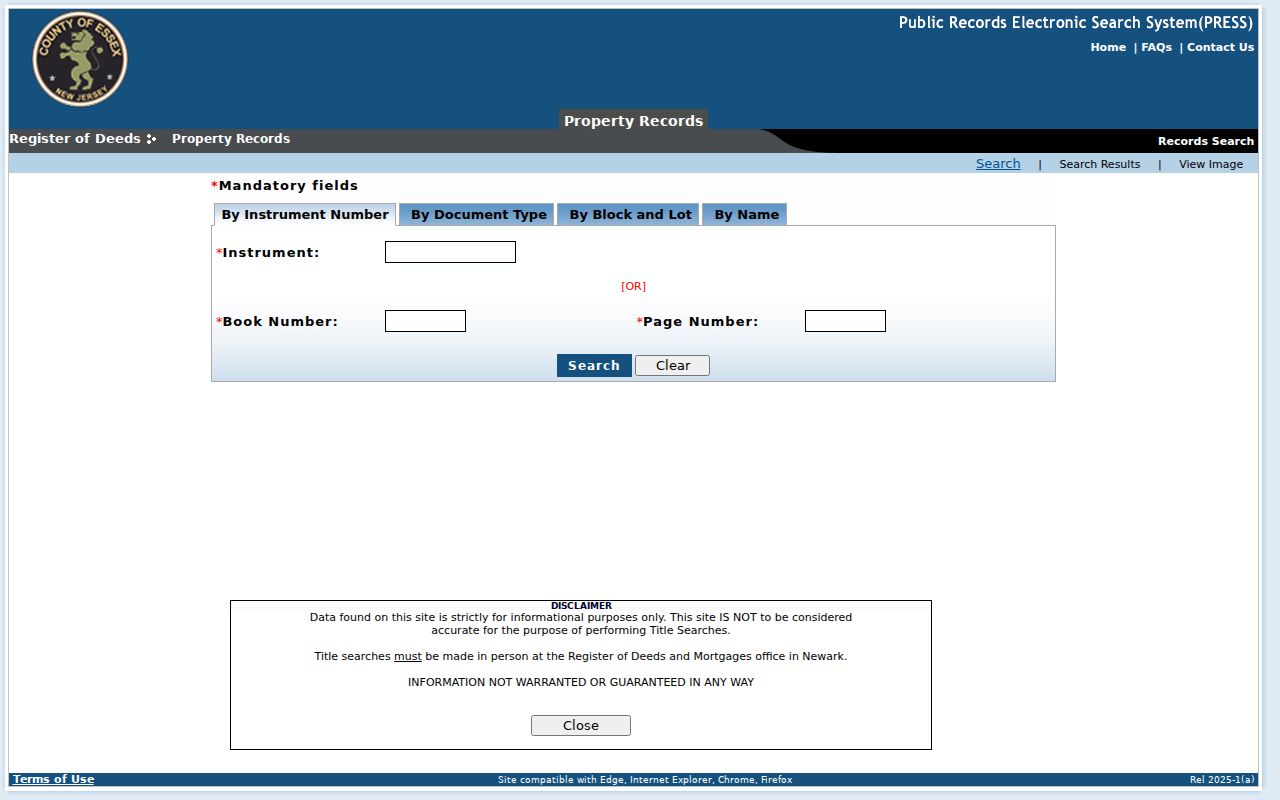
The block-and-lot route helps keep the deed chain tied to one parcel when names and street labels change.
Millburn Record Room Deed Access
Insider tip: treat the two online dates as different access statements. PRESS says its basic index is searchable from October 1, 1996, while the Register says electronic property transactions and office images begin May 1, 2001. The earlier date can help locate an index entry, but it does not guarantee a complete remote image. Mortgage cancellations before July 2, 2012 are also described as index-only without an electronic image. A past-residents search should record whether a fact came from an index, an image, a certified copy, or a book.
The Essex Register’s Record Room, Hall of Records, Room 130, 465 Martin Luther King Jr. Boulevard in Newark, preserves county legal documents recorded since 1637. Public inspection is listed Monday through Friday, 8:30 a.m. to 4:30 p.m. Staff may show how to use the index, books, and computers, but they do not perform a title search. The Map Room holds municipal and subdivision maps, and older book or index work can also continue through the State Archives.
For a mail copy request, give the owner name or names, approximate transfer date, address, and an optional book or page. The Register lists a certified deed or mortgage copy at $8 for the first page and $2 for each additional page. Its index is informational and not a title opinion, so a complex legal question needs the appropriate professional review.
Millburn Past Residents in Directories
Legal ownership is only one layer of who lived here before. The Millburn DigiFind-It archive contains a city-directory run from 1850 through 1981 with gaps, plus newspapers and local publications. A 1950 Price & Lee volume for Summit, Millburn, and Springfield includes a numerical street directory of householders and businesses, alongside an alphabetical directory of names, occupations, and addresses. The numerical section lets an address lead to a historical household snapshot rather than a deed party alone.
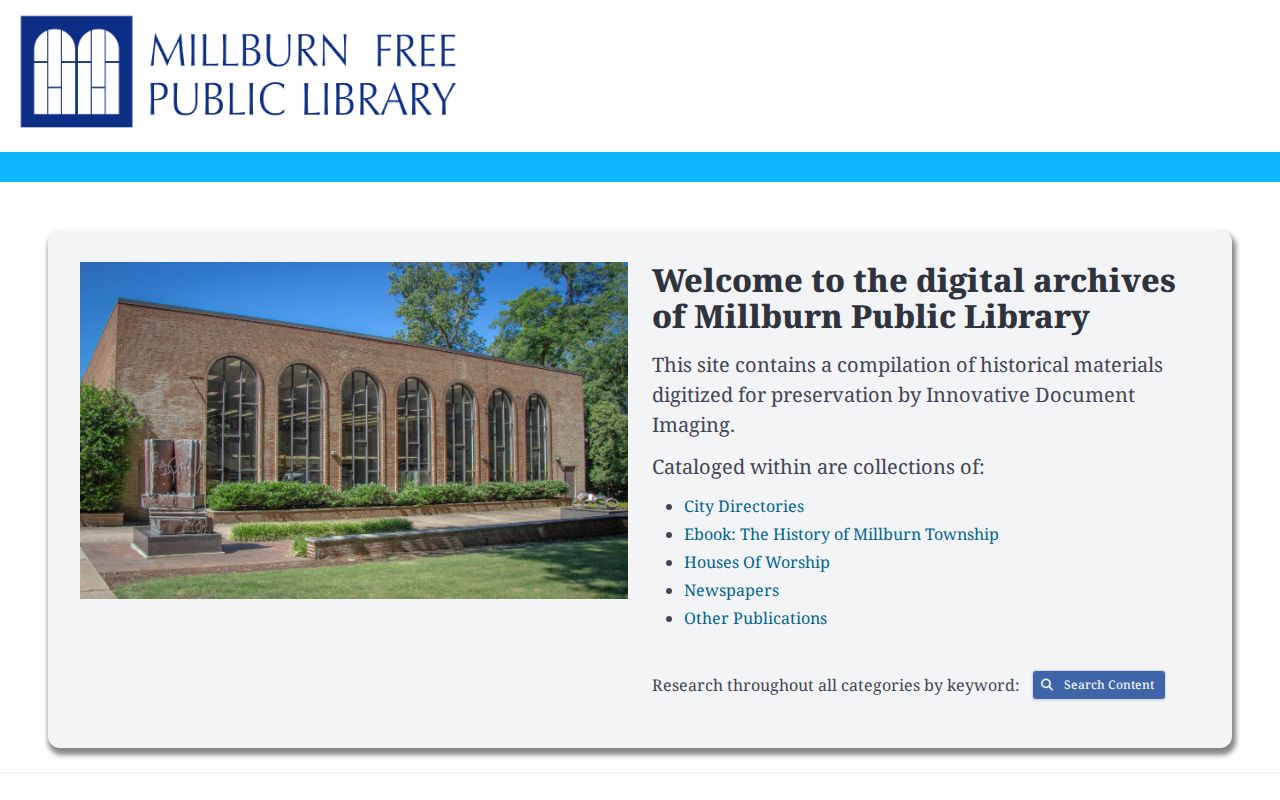
The library archive offers the directory and newspaper layer that can connect a date, address, and household name.
Work one available directory year at a time. Search the surname in the alphabetical listing, compare the numerical street entry, and write down the precise number, initials, occupation or business clue, and any notation that the volume actually explains. Then pair a directory period with the closest public census schedule. The research cites 1900, 1910, 1920, 1930, and 1940 schedules under the federal 72-year release rule. A directory gives a local commercial snapshot; the census gives a dated household snapshot. Neither substitutes for a deed or certified record.
The collection holdings and how entries read are covered in the Millburn city directories. Here, use them as one independent check in the address trail, especially when the person of interest is absent from a recorded ownership transfer.
Millburn Past Residents on Maps
Map work should come before a confident name match when the address is old or oddly labeled. The Millburn-Short Hills Historical Society Map Room includes Sanborn fire-insurance maps for 1886, 1895, and 1912, as well as local atlases and development maps. Sanborn sheets show building footprints, uses, streets, and lot context, not residents. A map can reveal that a building was not yet present, that a street name changed in a source, or that a parcel originated within a larger tract.
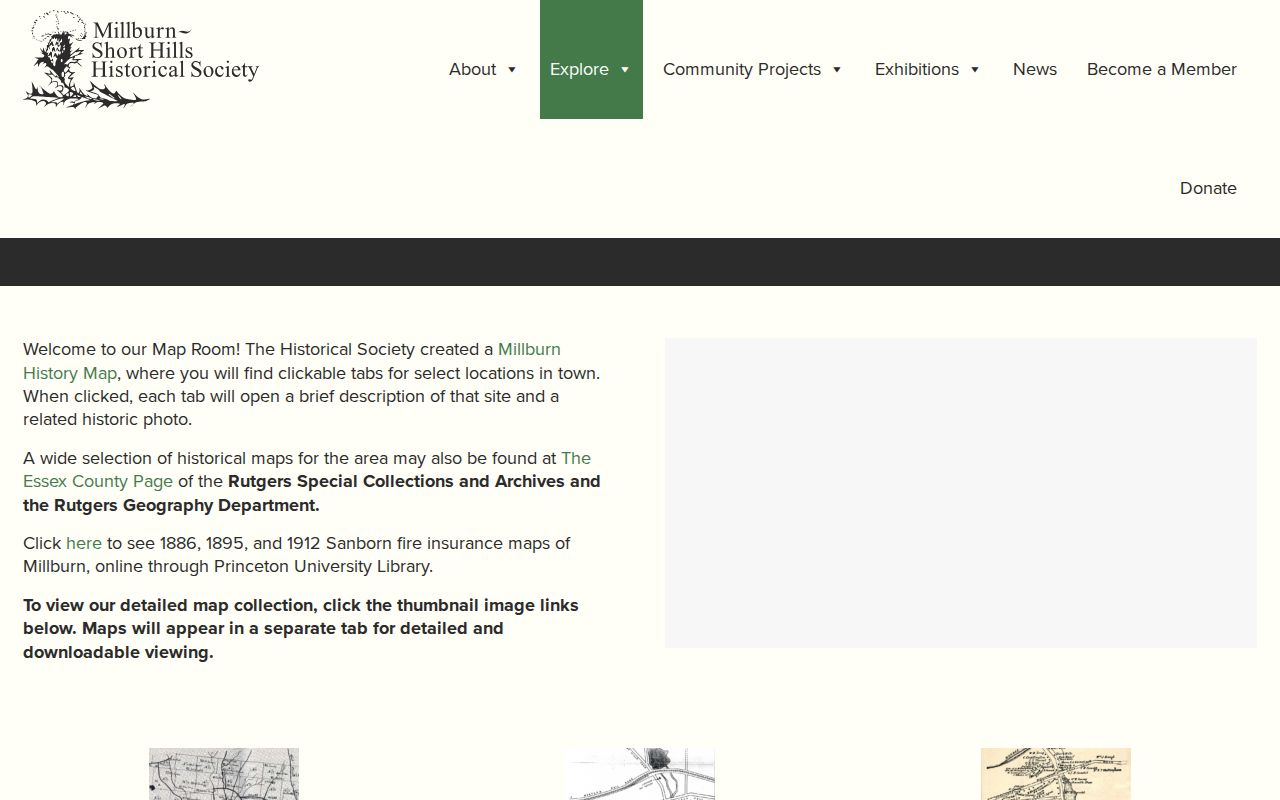
Map dates help place a directory entry or deed in the physical history of the parcel before a household conclusion is drawn.
The local preservation material identifies old routes such as Parsonage Hill Road, Old Short Hills Road, Hobart Avenue, Millburn Avenue, and Main Street, and it lists maps from 1859, 1879, 1881, 1890, 1907, 1922, and 1928. The Map Room also has a 1949 proposed Essex Street change. No definitive township-wide street-renumbering schedule was located. Search the older road name, tract or map name, adjacent owners, and block and lot together when a number does not carry across records.
Millburn Previous Residents House Archive
The Historical Society’s homes material adds local context to a legal trail. Its public archive has address-keyed Homes and a large Real Estate Records collection, alongside people, maps, photographs, organizations, schools, and local publications. The archive gives an exact-address search pattern: “67 West Road, Short Hills” becomes “WestRoad67SH.” Use the form shown by the archive, then compare the returned description, photograph, or real-estate clue with the parcel, directory, and deed dates already recorded.
The Historical Society Homes archive is the source for the address-keyed house-history search.
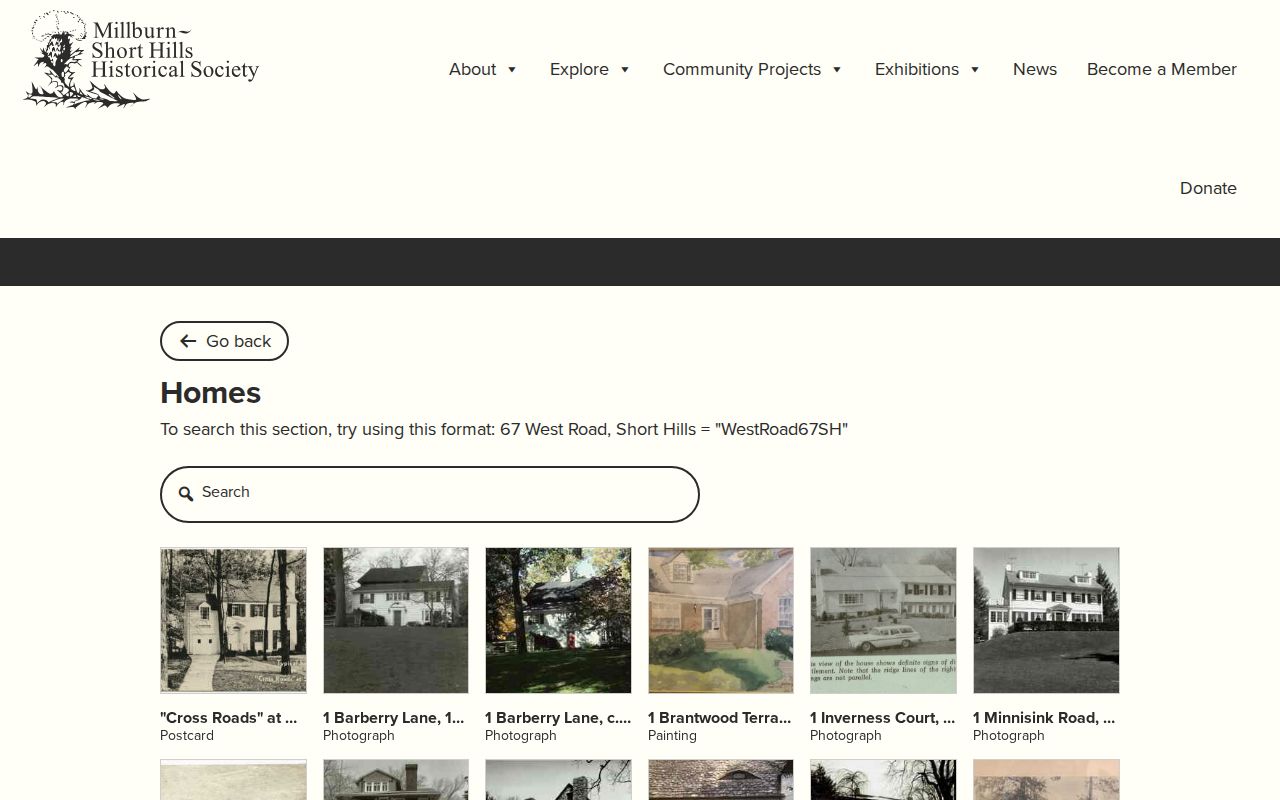
A homes result can supply a useful clue, but access and reproduction are member-supported and a selected archive item is not a full ownership record.
Newspaper records are a companion, not proof. DigiFind-It includes The Item for 1889 to 1891 and 1930 to 2025, plus other local runs. An obituary, property notice, or project story can generate a name or date to check against the Register, court or Surrogate route, and original custodian records.
Millburn Previous Residents Record Limits
Use two independent record types before stating that a person occupied an address. A deed dates a legal conveyance. A permit dates an application, construction, or inspection clue. A directory dates a reported address entry, and a newspaper dates a public notice. A person may be missing because the relevant source has a coverage gap, an address is filed under Millburn, Short Hills, or Wyoming, or the person was never named in that type of record. A person connected to a household may not appear in a property transaction.
Lawful use. Millburn house-history research supports personal, family, and property history. Do not use a past address trail to stalk, harass, intimidate, or harm anyone.
Protected addresses, privacy redactions, sealed material, and restricted record types can limit what appears in an index or image. The responsible next step is the office that keeps the original record, the library, Historical Society, State Archives, or a defined records request for an existing record. Preserve the source and date for every finding, and correct a mistake at its originating custodian.